

Ankle sprains are one of the most common musculoskeletal injuries – and one of the most underestimated. For many patients, what starts as a “rolled ankle” becomes a cycle of repeated sprains, persistent instability, and diminished activity. At Catalyst Orthopaedic & Sports Medicine, we want our patients to understand not just what happened to their ankle, but why it keeps happening – and what modern surgical options can offer when conservative treatment isn’t enough.
Understanding Ankle Sprains and Chronic Instability
The ankle is stabilized by a network of ligaments. The most commonly injured is the anterior talofibular ligament (ATFL), which runs along the outside of the ankle and resists inward rolling of the foot. A single significant sprain – or repeated minor ones – can stretch or tear this ligament, leaving the ankle feeling unstable, weak, or prone to “giving way.”
When symptoms persist beyond several months despite physical therapy, bracing, and activity modification, the diagnosis becomes chronic lateral ankle instability (CLAI). Our foot and ankle specialists often see patients who describe:
- A feeling that the ankle “gives out,” especially on uneven ground
- Persistent lateral ankle pain or swelling
- Difficulty returning to sports or physical activity
- A loss of confidence in the ankle
Left untreated, chronic instability can lead to cartilage damage, arthritis, and a progressive decline in activity level.

When Surgery Is Recommended
Surgery is typically considered when a patient has failed at least 3 to 6 months of conservative treatment and continues to experience instability. The goal is to restore the mechanical stability of the ankle so patients can return to the activities they love – safely and durably.
The gold standard surgical procedure for chronic lateral ankle instability is the Broström repair, in which the stretched or torn ATFL is tightened and reattached to the fibula. This procedure has been performed for decades with generally good results. However, research has revealed an important limitation: the repaired ligament, even when performed with suture anchors, is significantly weaker than the native ATFL. This means the repair is vulnerable to elongation – particularly with early movement – and traditionally required a prolonged period of immobilization to protect it while it healed.
That prolonged immobilization comes with its own costs: muscle atrophy, loss of proprioception, cartilage changes, and a slower return to activity.
InternalBrace Ankle Recovery: A Better Solution
The InternalBrace™ Ligament Augmentation (Arthrex) was introduced in 2012 to solve exactly this problem. Since then, over 500,000 devices have been implanted worldwide, supported by more than 213 published studies.
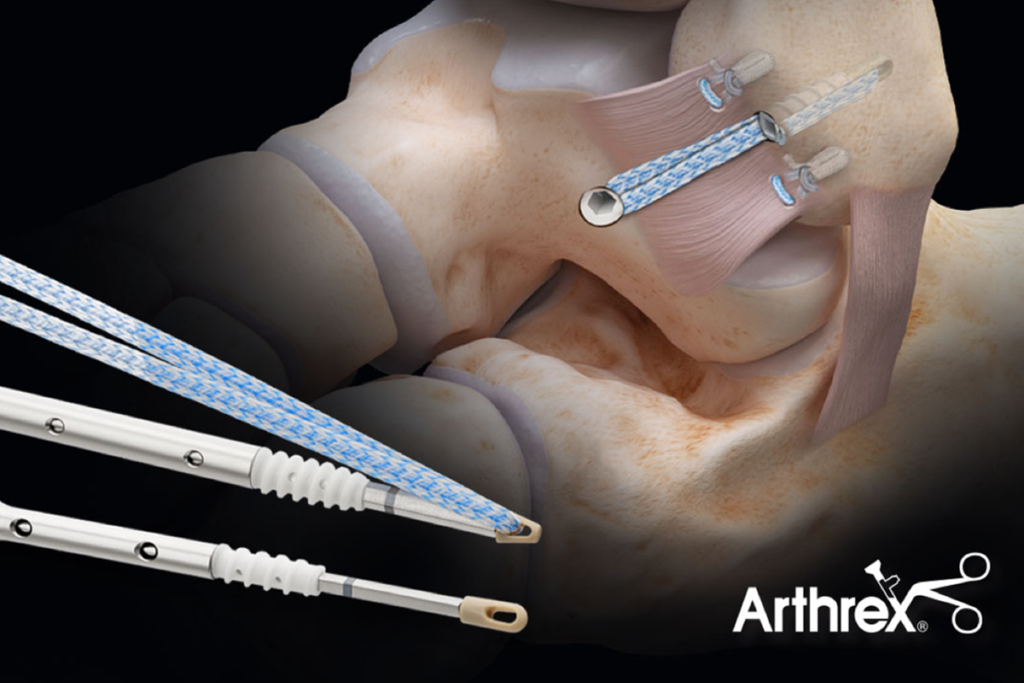
The concept is straightforward: the InternalBrace acts as an internal “check-rein” – a strong, flexible FiberTape construct anchored between the fibula and the talus that reinforces the Broström repair from the moment of surgery. Think of it like a seatbelt for your ankle ligament. It doesn’t replace the ligament; it protects it while it heals.
Why does this matter?
Biomechanical research has shown that the InternalBrace augmentation is at least as strong as the native ATFL – something a standard Broström repair cannot achieve on its own. Critically, the FiberTape is designed to mimic the natural stretch behavior of the ATFL, allowing controlled motion while preventing the excessive elongation that causes repair failure.
This means patients can begin early, protected rehabilitation without risking the repair – something that was not safely possible with traditional Broström surgery.
What the Research Shows
The clinical evidence supporting InternalBrace augmentation is compelling:
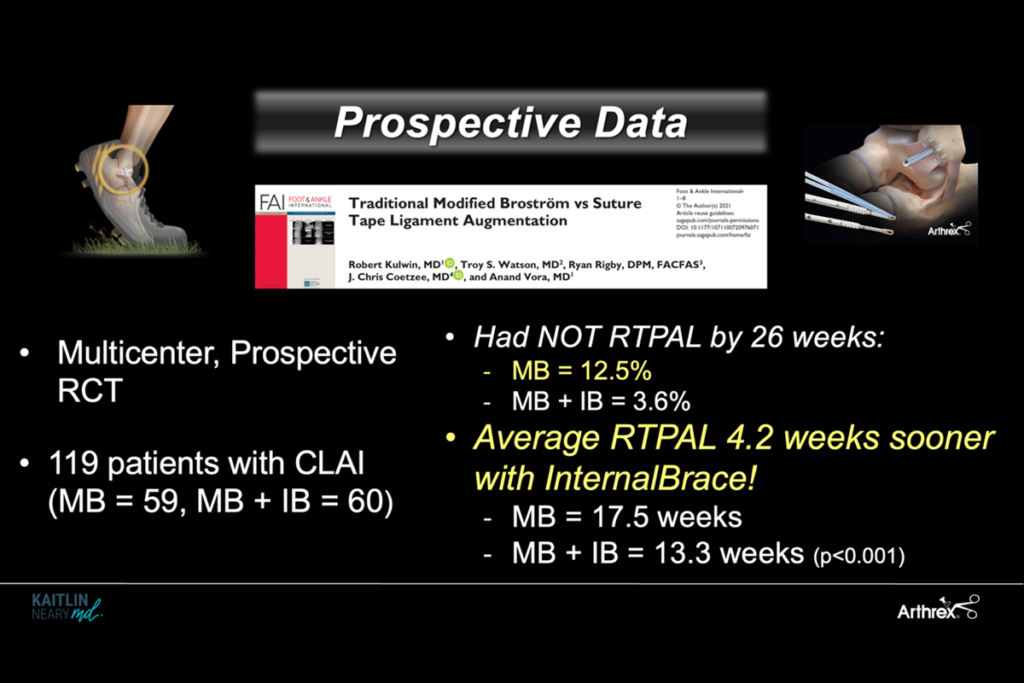
- A multicenter, prospective randomized controlled trial of 119 patients with chronic lateral ankle instability found that patients treated with InternalBrace augmentation returned to their previous activity level an average of 4.2 weeks sooner than those treated with standard Broström repair alone (13.3 weeks vs. 17.5 weeks, p<0.001).
- At 26 weeks, only 3.6% of InternalBrace patients had failed to return to activity, compared to 12.5% in the standard repair group.
- Multiple studies have demonstrated lower recurrence rates, improved functional outcome scores, and higher patient satisfaction with InternalBrace augmentation.
[IMAGE_PLACEHOLDER_56]
Is it cost-effective?
Research published by Dr. Neary and colleagues directly addressed this question. While InternalBrace augmentation adds modest upfront surgical cost, the analysis demonstrated that when accounting for the 4.2 extra weeks of physical therapy and lost wages associated with slower recovery in the standard repair group, the InternalBrace is the more cost-effective option – with a higher quality of life (0.07 QALY improvement) and a lower rate of revision surgery.
Recovery: What to Expect
One of the most meaningful benefits of InternalBrace augmentation is the ability to begin rehabilitation earlier and more aggressively. Most patients can expect:
- Weight-bearing beginning 1 week after surgery
- Early range-of-motion exercises within the first week
- Return to light activity around 3 – 4 weeks
- Return to sport or high-demand activity typically by 3 months
Every patient’s recovery is individualized based on their activity goals, the extent of their injury, and any additional procedures performed at the time of surgery.
Is InternalBrace Augmentation Right for You?
The InternalBrace is appropriate for a wide range of patients – from competitive athletes to active adults who simply want to walk on uneven terrain without fear. It is particularly well-suited for patients who:
- Have failed conservative management for chronic ankle instability
- Are highly active and want the fastest, most durable recovery possible
- Have had a previous Broström repair that has failed or stretched out
- Have ligamentous laxity or hypermobility that puts them at higher risk for repair failure
If you have been dealing with a chronically unstable ankle, you don’t have to accept it as your new normal. Modern surgical techniques offer durable, evidence-based solutions that can get you back to the activities you love – faster and with greater confidence than ever before.
Meet Our Specialists
Dr. Kaitlin Neary is a fellowship-trained surgeon in Boise specializing in InternalBrace ankle recovery and advanced Boise bunion correction. She works alongside Dr. Tracye Lawyer to provide Idaho athletes with the most advanced sports medicine and orthopedic care available. To schedule a consultation, contact Catalyst Orthopaedics today.
Updated April 2026 / Kaitlin C. Neary, MD, FAAOS is a fellowship-trained Orthopaedic foot and ankle surgeon at Catalyst Orthopaedics & Sports Medicine in Boise, Idaho.